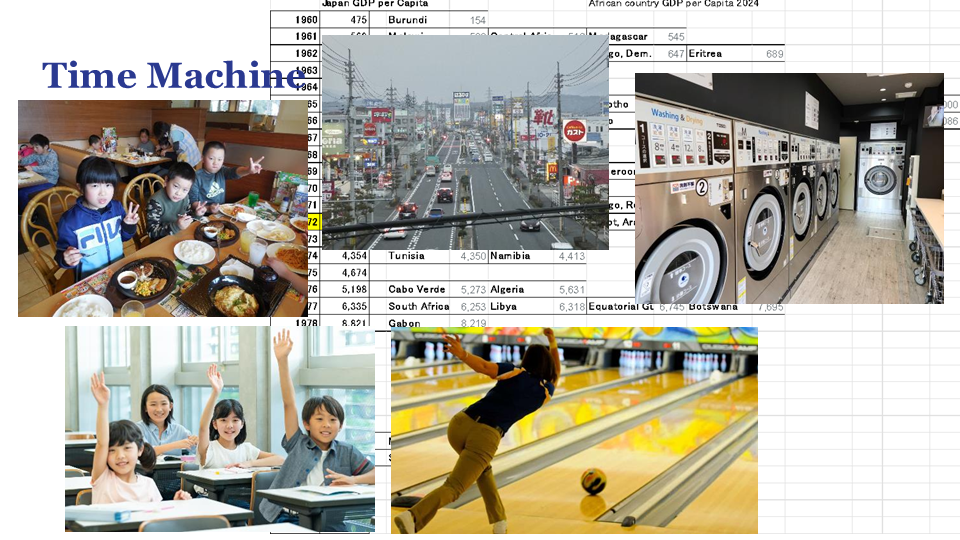
Traveling to the future aboard a time machine.
Traveling to the future aboard a time machine, then describing what you saw, heard, and experienced as if you were actually there. That, I believe, is vision.
Japan as a Time Machine: What Africa's Future Looks Like — and How to Get There Faster
What if you could look at a country's GDP per capita today and know — with remarkable precision — which industries are about to take off? Not by guessing, but by reading history.
That's the idea behind "Japan as a Time Machine."
The Insight That Changes Everything
Japan grew from a per capita income of $475 in 1960 to over $44,000 by 1995. That 35-year journey was not random. Each income level unlocked specific consumer behaviors, and those behaviors created specific industries.
Here's the striking part: many African countries today sit at income levels that Japan passed through decades ago. That means Japan's past is Africa's near future — not as destiny, but as a highly informative map.
Consider Tanzania. In 2024, its GDP per capita was approximately $1,186. Japan crossed the same threshold in 1967 — the year family restaurant chains began spreading across the country and the first cram schools opened to serve a newly aspirational middle class. Tanzania is, in economic terms, roughly where Japan was 57 years ago.
Or take Kenya, at $2,206 in 2024. Japan was at a comparable level in 1971, the year McDonald's and Mister Donuts opened their first Japanese locations, and the food service industry began its explosive growth.
The table below shows a selection of African countries alongside the year Japan had a similar income level — and the industries that emerged in Japan at that moment:
|
African Country (2024 GDP/capita) |
Japan equivalent year |
What was happening in Japan |
|---|---|---|
|
Tanzania ($1,186) |
~1967 |
Family restaurants, cram schools |
|
Kenya ($2,206) |
~1971 |
McDonald's, fast food chains, coffee shops |
|
Ghana ($2,406) |
~1971 |
Franchise food chains, consumer services |
|
Morocco ($3,993) |
~1973 |
Yoshinoya franchise, supplemental education |
|
Tunisia ($4,350) |
~1974 |
Diversified dining, beauty services |
|
Namibia ($4,413) |
~1975 |
Consumer convenience, early retail chains |
|
South Africa ($6,253) |
~1977 |
Fine dining, branded chains |
|
Gabon ($8,219) |
~1978 |
200+ chain restaurants, nail salons |
|
Mauritius ($11,872) |
~1985 |
Premium dining, lifestyle services |
|
Seychelles ($17,859) |
~1986 |
Nail salons, luxury hospitality |
The pattern is not coincidental. Rising incomes free up time and money. Families eat out more. Parents invest in children's education. Women gain economic autonomy and spend on personal care. These are not cultural quirks — they are near-universal human responses to growing prosperity.

Why This Matters More Than It Might Seem
The "time machine" frame is more than an intellectual exercise. It has a practical implication: entrepreneurs who understand where their country is on Japan's historical timeline can anticipate demand before it peaks — and build the businesses that will serve it.
This is precisely the logic behind franchising as a development tool.
A franchise, at its core, is "buying time to success." Not buying success itself — but buying the accumulated experience of a franchisor: their mistakes, their refinements, their systems. A franchisee in Mozambique who partners with a proven Japanese operator doesn't need to reinvent the wheel. They skip 20 years of trial and error and begin closer to where their market is heading.
Japan, with its 60-year archive of industry evolution at every income bracket, is an extraordinarily rich source of that experience.
From Theory to Practice: Two Real Stories
The Laundromat That Started with a Conversation
In October 2022, a young man from Mozambique — then studying in Japan on a scholarship — approached me after a lecture. He had been surprised to find laundromats on nearly every corner in Japan. He wanted to bring one home.
"In Mozambique," he told me, "a single laundry session for a large family can take three or four hours. The work almost always falls to women. A female friend from university had no time to study because of her family's laundry."
That conversation led to years of work: visiting laundry equipment suppliers, negotiating with manufacturers, studying the container laundromats that were popular in Japan during the 1970s (roughly Tanzania's income level today). In October 2024, the first store opened in Mozambique. Political turmoil forced a four-month delay before the doors could open — but it opened. A second location followed. Kenya is next, with Liberia, Gabon, and Madagascar in the pipeline.
Mozambique's 2024 per capita income is $647 — approximately where Japan was in 1962. Container laundromats began spreading in Japan in the 1970s, when incomes reached around $4,000–$9,000. That gap is the entrepreneur's runway. He's not late. He's early.
TOKYO8: Microfranchising for Agriculture
A student from Liberia — not an agricultural expert, but someone who felt the weight of his country's food insecurity — teamed up with peers studying agronomy and began working with TOKYO8, a microbial soil enhancer developed in Japan. Together, they proved the product in Liberian conditions, adapted the model for local production (reducing expensive imports by manufacturing the solution locally), and launched a project to grow vegetables on school farmland and provide free lunches to children.
The model is now a microfranchise: a simple production plant, 3,000 liters per month output capacity, scalable without large capital. He presented the work at a TICAD 8 official side event.
These two stories share a structure: a Japanese solution, proven at a specific income level in Japan's history, transferred by a person who understands both countries — and franchised so it can multiply.
The Bigger Frame: Human Capital as the Bridge
The "time machine" only works if someone can read both clocks — Japan's past and Africa's present. That person is usually someone who has lived in both worlds.
Japan's ABE Initiative and JICA scholarship programs have sent thousands of African professionals to study in Japan. Many return with exactly the skills and networks needed to operate this kind of transfer. They understand Japanese business culture. They understand their home country's real needs — not the sanitized version that surfaces in market reports, but the daily friction: unreliable power, informal logistics, limited credit, family obligations that reshape time use.
The most interesting businesses emerging from this cohort are not copies of Japanese concepts. They are adaptations — solving African problems with frameworks refined in Japan. The laundromat in Mozambique runs on solar power and mobile payments. TOKYO8 is produced locally to avoid customs costs. The franchise model itself is modified for revenue-sharing arrangements that account for the reality that many franchisees start with very little capital.
What Comes Next
The next wave we are exploring: vending machines running on mobile payment systems (M-Pesa and its equivalents), secondhand Japanese machinery repurposed for African markets, and an expanding franchise network that connects Japanese equipment suppliers and operators with African entrepreneurs who have the on-the-ground knowledge to make them work.
None of this requires believing that Africa will simply repeat Japan's trajectory. History doesn't replay — it rhymes. But the rhyme is close enough to be useful. When you know that Japan's cram school industry exploded as per capita income passed $1,200, and you are launching an education business in Tanzania today, that is not trivia. It is a strategic signal.
The time machine doesn't carry you into the future. It shows you what the future looks like — and gives you a head start building for it.
Nobuhiko Matsumoto is a director of Assentia Holdings, a business design firm working at the intersection of Japanese business expertise and African market development. He has worked with ABE Initiative and JICA scholars since 2017 and has been involved in franchise development projects across Mozambique, Liberia, Kenya, and beyond. Contact: